About Measles
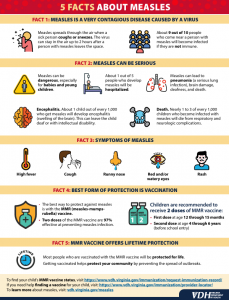
Measles is a highly contagious viral illness that spreads easily through the air when an infected person breathes, coughs, or sneezes. The virus can remain in the air for up to two hours after the infected person leaves the area. Measles symptoms include a cough, runny nose, rash, and sometimes red, itchy eyes. Measles is preventable through a safe and effective MMR vaccine. Two doses of the vaccine are given to provide long-lasting protection.
In 2025 and to date in 2026, Virginia has experienced an increase in measles. These cases have resulted from travel (international and domestic) and household/close contact exposure (e.g., spread from one family member to another).
For more information about the measles virus, please visit the measles fact sheet page.
2026 Measles Cases
VDH 報告 Five cases of measles in 2025.
| 地區 | 計數* |
|---|---|
| 中部地區 | 1 |
| 東部地區 | 1 |
| 北部地區 | 9 |
| 西北地區 | 0 |
| 西南地區 | 6 |
| 總計 | 17 |
| 年齡層 | 計數* |
|---|---|
| 0-4 歲 | 10 |
| 5-12 歲 | 1 |
| 13-17 歲 | 2 |
| 18 歲以上 | 4 |
| 總計 | 17 |
Tables and graphs will be updated as new cases are reported. Last updated: Mar. 25, 2026.
VDH 在調查確定某人於特定時間和地點在公共場所可能接觸到麻疹時,會發布通知。
如果您接觸過,該怎麼辦:
- 監測症狀: 如果您接觸過,尤其是如果您未接種疫苗 免疫 透過接種疫苗或既往感染,注意麻疹症狀。
- 報告您的暴露情況: 完成此項 簡短調查 請通知當地衛生部門。如果需要採取其他步驟,公共衛生官員會與您聯絡。
- 如果您出現麻疹的症狀: 請立即聯絡醫療保健提供者。前往醫療機構或急診室前,請提前致電。告訴他們您可能已經接觸到麻疹,並請他們聯絡當地的衛生部門。這有助於保護其他病患與員工。
重要注意事項:
- 暴露風險僅限於已公布的特定日期和時間。一旦過了這段期間,該地點就不會持續有麻疹暴露的風險。
- 所列的企業和地點不對麻疹患者的出現負責。
活躍暴露場所:
| 地點 | 日期和時間 | 症狀觀察期最後一天 |
|---|---|---|
| 目前沒有活躍的接觸地點 | ||
Table will be updated when additional exposures are identified. Last Updated: Mar. 25, 2026.
Virginia residents with questions about measles can email the Virginia Department Health at epi_response @vdh.virginia。gov or contact their 當地衛生部門。
- March 4: Virginia Health Officials Investigating a Potential Measles Exposure in Southwest Region
- February 19: Virginia Health Officials Investigating Two Confirmed Measles Cases in Northern Virginia
- February 16: Virginia Health Officials Investigating Confirmed Measles Case in Northern Region
- February 6: Virginia Health Officials Investigating a Confirmed Measles Case and an Exposure in Northern Region
- 2 月4: Virginia 衛生官員正調查北部地區一宗確診麻疹個案
- 1 月 30 日: Virginia 衛生官員正在調查北 Virginia 地區一起潛在的麻疹病例
- 1 月 20 日: Virginia衛生官員調查北部地區另一宗確診麻疹個案
- 1 月 11 日: 弗吉尼亞州衛生官員調查北部地區確診麻疹個案
Measles symptoms usually appear in two stages. About 7 to 14 days after being exposed to measles, the first signs and symptoms of illness begin. These include a fever of greater than 101 degrees, runny nose, watery red eyes, and a cough. Small white spots, called Koplik spots, also may be seen on the gums and inside of the cheeks. These can appear a few days after initial symptoms begin.
The second stage of illness starts 3 to 5 days (range of 1 to 7 days) later. In this stage, a 皮疹 begins on the face and spreads to the rest of the body.
While many patients recover from measles, some experience severe complications, such as pneumonia, encephalitis, deafness, or other serious infection 由於 damage to the immune system。
- One in five measles patients will require hospitalization.
- One in twenty children with measles will get pneumonia, the most common cause of death from measles in young children.
- 之間 one and three of every 1,000 children with measles die from complications.
- The likelihood of death (by any cause) increases in the years immediately following a measles infection due to the measles virus’ ability to erase immune memory.
你是 considered immune or protected against measles if you have any of the following:
-
- Received the recommended number of measles-containing vaccines based on your age and exposure risk (see “How do I find my immunization record?”).
- A laboratory test confirmed that you had measles at some point in your life or are immune to measles.
- 您在 1957 之前出生。
VDH promptly issues notifications when an investigation identifies a specific time and place where someone with measles may have been in a public setting. If you were exposed to measles:
- Check if you are protected. You are considered immune or protected against measles if you have any of the following:
- Received the recommended number of measles-containing vaccines based on your age and exposure risk (see “How do I find my immunization record?”).
- A laboratory test confirmed that you had measles at some point in your life or are immune to measles.
- 您在 1957 之前出生。
- Report your exposure。 Public health officials will contact you if additional steps are needed or if you might be eligible for post-exposure medications that can protect you from getting measles or reduce how sick you become if you do get measles.
- Watch for symptoms for 21 days. This is especially important if you are not immune through vaccination or previous infection. (See “What are the symptoms and complications of measles?”)
- If you experience symptoms of measles, contact a healthcare provider right away. Call ahead before going to a doctor’s office or the emergency room. Tell them you may have been exposed to measles and ask them to contact the local health department. This helps protect other patients and staff. Call 9-1-1 if it is a medical emergency.
- 如果您是 immunocompromised, consult with your healthcare provider if you have questions or develop symptoms.
- If you are not immune, you should stay away from others until your healthcare provider says it is okay to return to your normal activities. This is especially important if you might go into settings with susceptible people such as schools, hospitals, and childcare facilities.
No treatment that specifically targets measles is available。 Treatment for measles is supportive, focusing on symptom relief as the body fights the virus. This might include fluids, fever-reducing or pain medication, antibiotics to treat secondary bacterial infections, and vitamin A supplements given under the supervision of a healthcare provider.
If someone without immunity to measles is exposed to a person with measles, post-exposure prophylaxis (PEP) might be administered to reduce the likelihood of developing measles or severe complications from measles. Because there is a narrow window of time during which PEP is effective at preventing measles from developing, it is important that you notify VDH of your exposure as soon as possible.
You can securely view, download, and print your Virginia immunization record anytime using the 申請疫苗接種記錄 electronic portals. Also check:
- Previous vaccine providers. Don’t forget vaccination visits you made to local public health departments or neighborhood clinics.
- Your home and in family records. Look through your old papers, including baby books and school or camp forms.
- 其他 state or local registries. All states and some cities have centralized registries of vaccine records.
- Schools and colleges or other post-secondary institutions you or your child attended.
- Previous employers, including the military.
是的。 Most Virginians are immune to measles through either vaccination or a past infection.
As of 2026, the measles vaccination rate for kindergarteners in Virginia is high (95%). However, there are communities in Virginia with lower vaccination rates. These communities are at increased risk of measles outbreaks. Many communities worldwide and within the U.S. have seen measles outbreaks in recent years when vaccination rates drop below 95%.
Yes. MMR (measles, mumps, rubella vaccine) has been licensed and administered widely in the U.S. since 1971. Decades of MMR use worldwide have demonstrated that it is safe, effective, and has no evidence of causing long-term harm.
Before the introduction of the first measles vaccine, 400-500 people died of measles complications each year in the United States, and nearly 50,000 people were hospitalized with measles complications annually.
No. Vitamin A does not prevent measles infection. Vaccination is the only way to prevent measles. Vitamin A may be administered under the supervision of a healthcare provider as part of supportive care for someone with severe measles illness. Overuse of Vitamin A can lead to toxicity and cause damage to the liver, bones, central nervous system, and skin.
Avoid taking high levels of vitamin A if you are pregnant, as it has been linked to severe birth defects。
Parents are encouraged to discuss questions and concerns about measles and vaccination with their child’s healthcare provider. Children need vaccines to maintain immunity at an individual and population level. Vaccine-preventable diseases are still common in other parts of the world, and some are increasingly common in the U.S.
MMR vaccine is recommended for all children, starting with the first dose at 12-15 months of age, and a second dose before a child enters kindergarten (4-6 years of age). The second dose can be administered earlier, as long as it is at least 28 days after the most recent dose.
Infants 6-11 months of age who will be traveling internationally, or to an outbreak setting, may also receive an early dose of MMR. Talk to your healthcare provider or 當地衛生部門 if you have an infant 6-11 months of age and are interested in MMR.
Can I get the measles vaccine while I am pregnant?
No. Live virus vaccines, such as MMR, should not be given to people who are pregnant. MMR should be administered either at least 28 days before pregnancy or after pregnancy.
If you would like to receive MMR after pregnancy, it is safe to do so while breastfeeding.
What should I do if I do not have immunity to measles and was exposed to someone with measles while pregnant?
If a non-immune person who is pregnant is exposed to measles, immune globulin (IG) would generally be administered. IG can reduce the likelihood of developing measles or severe complications of measles. IG must be administered quickly after exposure, so it is important that you notify VDH and your healthcare provider of your exposure as soon as possible.
Do newborns receive protection from measles from their mother during pregnancy?
Newborns may be protected from measles during their first few months of life through maternal antibodies if the mother has received MMR vaccine or acquired natural measles immunity. However, measles protection from maternal antibodies is highly variable and wanes rapidly. IG is generally recommended for exposed non-immune infants regardless of the mother’s immune status.
- Measles outbreaks are occurring 全球 and in parts of the United States.
- 請檢查您 目的地 和 CDC’s Global Measles Travel Health Notice for travel health advice and talk to your healthcare provider if you plan to travel internationally.
- Before traveling internationally or to an outbreak area:
-
- Make sure everyone is protected against measles. (See FAQ- "I think I was exposed to measles. What should I do?" - “You are considered immune or protected from measles if...”)
-
- If you need vaccine, schedule your appointment at least 2 weeks before you leave.
-
- Infants 6 through 11 months of age typically should receive one dose of MMR vaccine before travel.
- After you return, watch for signs and symptoms of measles for 3 weeks. If you or your child gets sick with a rash and a high fever, call your healthcare provider and tell them you traveled to an area with active measles spread.