長期的乾旱會帶來環境、經濟和社會的影響。乾旱直接影響飲用水供應的數量和質量。
維吉尼亞州衛生部飲用水辦公室 (VDH -ODW)12 是Commonwealth of Virginia 維吉尼亞州乾旱評估和應對計畫 指導下監測 乾旱狀況及其影響的 合作夥伴之一。這些監測工作由弗吉尼亞州環境質量部(DEQ)通過一個稱為乾旱監測工作小組(DMTF)的組織帶領。
在 DMTF 的領導下,VDH-ODW 負責監測和報告與乾旱情況相關的水廠運作狀況。
ODW 的 DMTF 最新報告
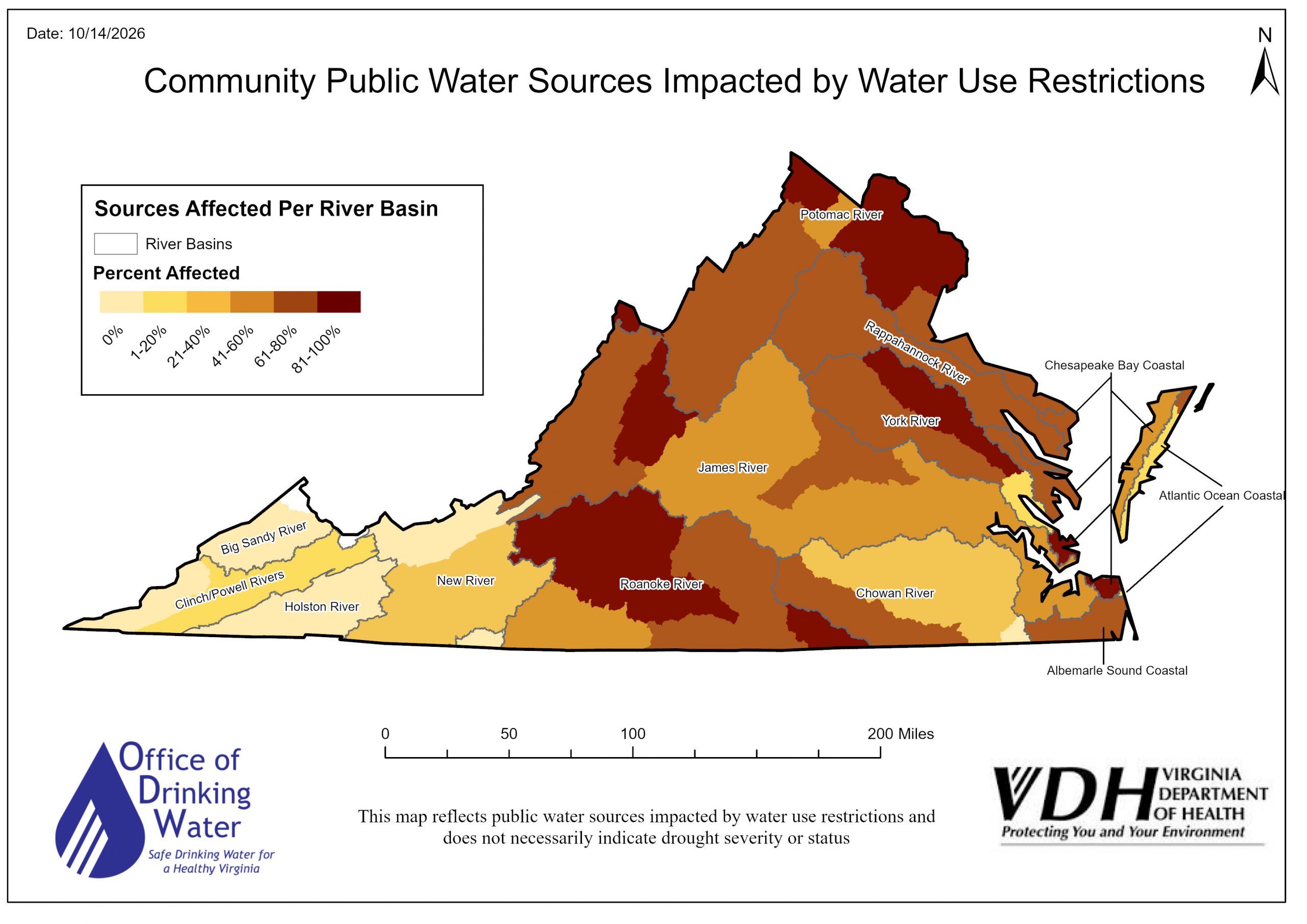
VDH-ODW 的乾旱監測圖和趨勢如下說明。該地圖反映了Virginia主要河流域內在乾旱限制下運作的公共水源百分比。
按一下此處以存取最新的乾旱摘要報告
其他有用的鏈接
- EPA 有關水事業的乾旱應對和恢復工具
- USGS 地面水實時流量
- Managing Your Private Well During a Drought (VDH)
- Hauling Water guidance – Chapter 16 of the 現場操作手冊 (VDH)
- Virginia Drought Assessment and Response Plan
- Mutual Aid Organization for Waterworks: www.vawarn.org
- Emergency Response Plan Template
ODW Drought FAQs
A well is said to have gone dry when water levels drop below a pump intake. This does not mean that a dry well will never have water in it again, as the water level may come back through time. The water level in a well depends on a number of things, such as the depth of the well, the type (confined or unconfined) of aquifer the well taps, the amount of pumping that occurs in this aquifer, and the amount of recharge occurring.
Loss of pressure and/or water service, along with sputtering faucets (air in water), cloudy or gritty water, while using your well water can be indicators that the well may be going dry. This can occur when the water level in the well is pumped down to the well pump inlet — resulting in the loss of water pressure and/or water service. If water use is stopped and the well is allowed to rest, it may refill and water service is restored. Owners should be careful not to run the pump while the water level is low as this could damage the pump.
Yes. An electrical problem with A switch, circuit breaker, supply wiring, or a failure of a submersible pump can cause loss of pressure and/or water service. The owner should contact a licensed water well system provider to determine the cause.
When the water level in the well is low, the operator might notice a reduced pumping rate and lower well pump discharge pressure, even if there are no symptoms of sputtering faucets or gritty water. An operator could measure the static water level and pumping water 水平 (at the end of a pumping campaign) and compare current levels with historic levels, and the pump intake level. When the pumping water level approaches the pump intake level, the well may be in danger of going dry。
The operator can reduce the pumping rate to match the pumping rate to the flowrate of water into the well. For some waterworks, the operator can shorten the duration of the pumping period by adjusting the well controls.
Generally, groundwater is recharged during the late fall, 冬天 and spring. During the growing season there is not enough precipitation to recharge the groundwater. Owners that depend on groundwater likely will not see significant improvement in groundwater levels until winter precipitation arrives.
During declared drought emergencies, local governments are the primary entities responsible for enforcing mandatory water restrictions. Please contact your local government representative regarding any enforcement-related concerns.
Monitoring well levels can be a challenge, particularly for smaller systems. One way is to use a 水 level sensor tape, which requires measuring both the static and pumping (at end of pumping campaign) water levels. The well pump intake level must also be known. Another method for monitoring water levels in wells is through the use of a sonic water level meter. A pressure transducer/datalogger can also be used to record the height of the water column over the top of the transducer.
An Emergency Operations Plan template can be found 這裡。 Waterworks are encouraged to share water levelS and emergency response planS 與 ODW field offices and our Source Water Protection team 在 SourceWater @vdh.virginia。gov. See 22VAC40-73-950. Emergency preparedness and response plan 如需更多資訊。
It can be beneficial to waterworks to explore leak detection and other pathways to reduce water loss within the distribution system. The Department of Energy has resources on reducing distribution leaks 這裡。