
在此頁面上: 儀表板指南 | 弗吉尼亞州 ACH 設施 | 全州 SIR | 全州 SUR | 醫院特定報告 | 設備 相關事件 | 設備 使用情況 | 手 術部位感染 | 實驗室確 定事件 | HCP 流感 疫苗
HAI/AR 計劃每年都會發布報告,為醫療機構和預防應對措施提供信息,以幫助減少弗吉尼亞州急診醫院 (ACH) 患者的醫療相關感染 (HAI)。
醫療保健相關感染(HAI),以前稱為醫院感染,是在接受醫療護理時所感染的感染。患者可以從例行護理、手術、使用呼吸器或導管等醫療設備的併發症,或是過度使用抗生素的副作用。
有關更多信息,請參閱「導航」部分下發布的鏈接。
下載國家衛生安全衛生動力系統數據。
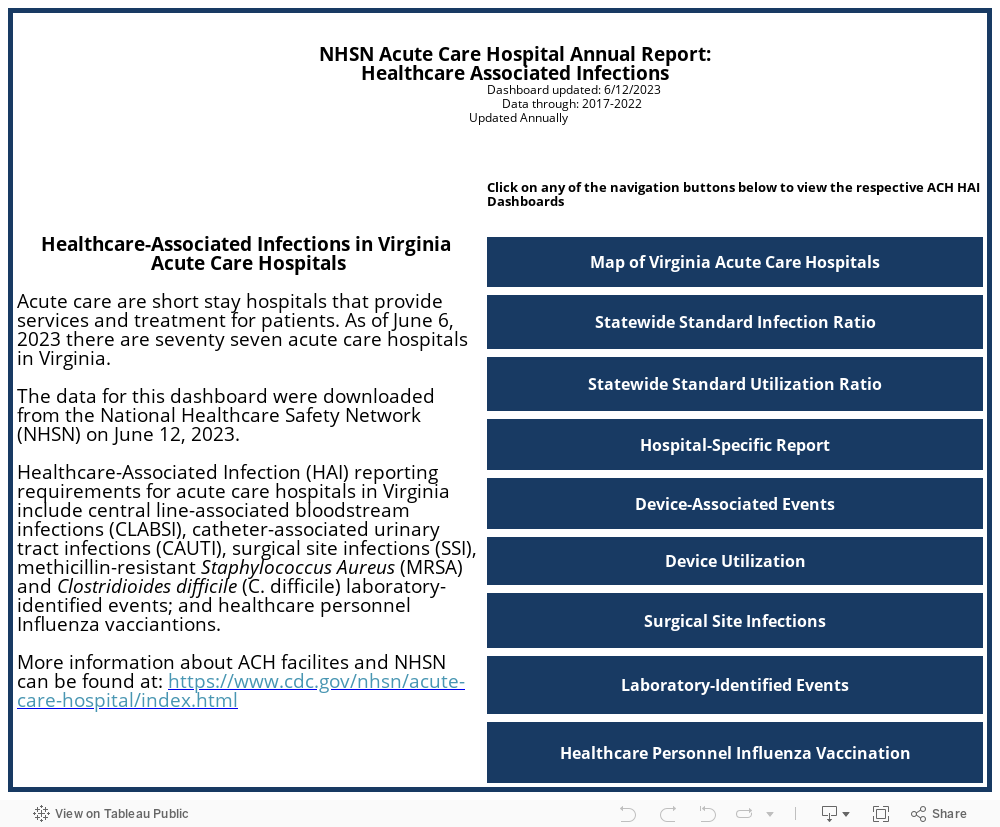
HAI ACH 年度報告儀表板簡介 (導覽)
指南
Data collected for the years of 2022-2025 were downloaded from the National Healthcare Safety Network (NHSN) on September 4, 2026. Any changes made to the data after this date are not reflected in the results. This one-time retrieval was necessary to incorporate the updated 2022 baseline, which replaced the previously used 2015 baseline.
Note: Data for 2019–2021 are not displayed in this dashboard because they are not available using the updated 2022 baseline. Historical data for these years (using the 2015 baseline) may be requested by emailing hai@vdh.virginia.gov.
The 2025 NHSN Patient Safety Component Annual Hospital Survey was used to gather information on hospital characteristics (e.g., hospital bed size and medical school affiliation).
定義:
VDH Health Planning Region
There are five public health planning regions in Virginia (Central, Eastern, Northern, Northwest, Southwest). The health planning regions allow public health to conduct surveillance and assess health needs across different areas of Virginia.
Healthcare Coalition Region
The Virginia Healthcare Emergency Management Program was created through a partnership between VDH and the Virginia Hospital & Healthcare Association (VHHA), enhancing hospital and healthcare system capabilities to respond and recover from a wide range of public health and healthcare emergencies. VDH and VHHA work with hospitals and healthcare facilities through a regional structure that consists of four healthcare coalitions (Central, Eastern, Northern, Southwest). More information is available on the VDH Hospital and Healthcare Preparedness page.
Hospital System
醫院系統或醫療保健系統是由中央組織擁有、贊助或合同管理的兩家或多家醫院。
Medical School Affiliation
Medical school affiliation equals ‘Yes’ if the hospital answered ‘Yes’ to the following question on the NHSN Patient Safety Component Annual Hospital Survey: Is your hospital a teaching hospital for physicians and/or physicians-in-training? Includes major teaching (facility has a program for medical students and post-graduate medical training (i.e., residency and/or fellowships), graduate teaching (facility has a program for post-graduate medical training, i.e., residency and/or fellowships only), or undergraduate (facility has a program for medical students only).
Bed Size
Bed size is defined as the number of beds set up and staffed in all inpatient locations.
Standardized Infection Ratio (SIR) = Number of observed infections / Number of predicted infections
The standardized infection ratio (SIR) is a summary measure that can be used to track HAIs over time and can be calculated on a variety of levels, such as unit, facility, state, and nation. The SIR adjusts for differences between hospitals, such as types of patients and procedures, as well as other factors. SIRs indicate whether the observed number of infections is higher, lower, or similar to the predicted number of infections based on national baseline data from 2022.
In the dashboard, the “SIR interpretation” adds information so the user knows if the SIR is statistically significant:
- If the SIR interpretation is 更好, then the number of observed infections was significantly lower than the number predicted.
- If the SIR interpretation is 相同, then the number of observed infections did not significantly differ from the number predicted.
- If the SIR interpretation is 更糟, then the number of observed infections was significantly higher than the number predicted.
- If the SIR interpretation is 沒有結論, then the SIR was not calculated because the number of predicted infections was less than 1.
Standardized Utilization Ratio (SUR) = Number of observed device days / Number of predicted device days
標準化的使用率比率 (SUR) 可衡量設備使用率,並且是可擴展、風險調整後的量度,可以在不同地點和設施進行比較。根據 2022 的國家基準數據,SUR 指出觀察到的設備天數是否更高、更低或類似於預測的設備天數。
針對急診醫院的非 NICU 位置,中央線路和導管 SURS 會根據設施類型、醫學院附屬性、住院病床數和患者照護地點類型進行風險調整。NICU 地點中央線路的 SUR 會根據設施類型、醫學院所屬性、住院病床數、NICU 類型(II/III 級與第三級)以及 NICU 患者的出生重進行調整。
FAQs: NHSN 2022 HAI Rebaseline
Where can I find data using the old (2015) baseline?
- Please email hai@vdh.virginia.gov to request data using the 2015 national baseline.
Where can I find more information about the new baseline?
How will the new baseline change my facility’s SIR?
- This is covered by CDC’s Understanding the Impact of the 2022 HAI Rebaseline presentation.
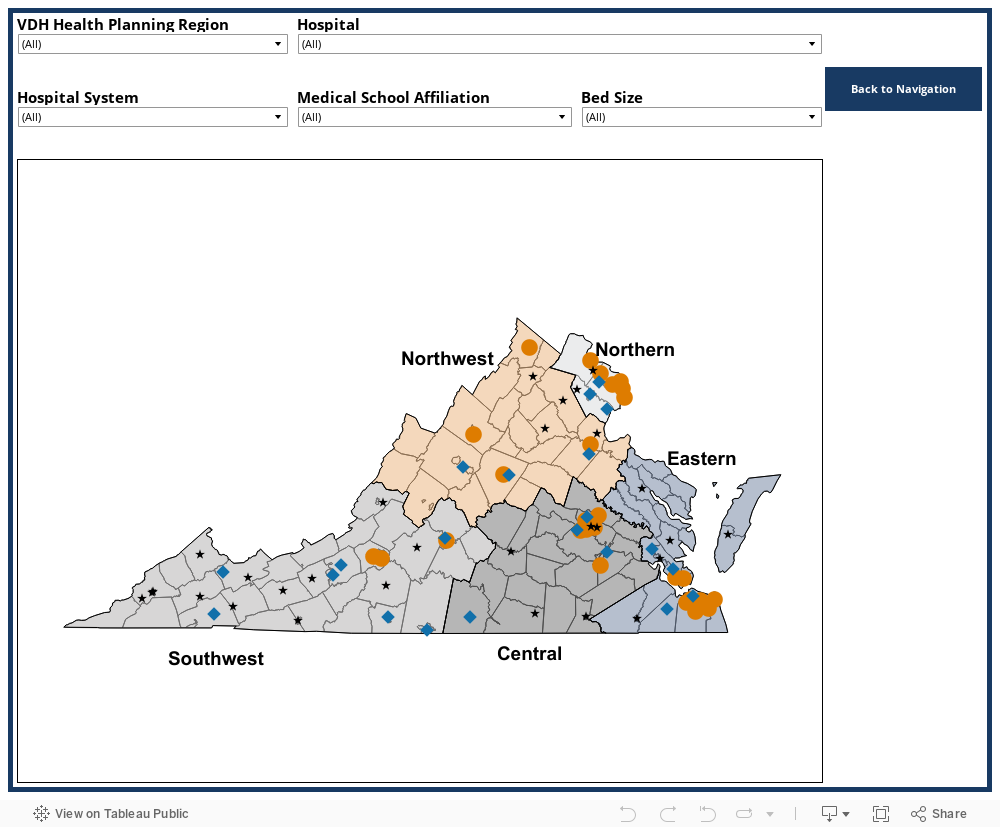
地圖
此標籤顯示在 NHSN 中報告的急診醫院的位置。 五個 VDH 衛生規劃區域分別以不同的顏色表示。
醫院以不同顏色和大小的形狀表示:
- 黑星:最小醫院(≤ 100)
- 藍鑽:中型醫院 (101-200)
- 橙色圈:最大的醫院 (> 200)
如需有關每個醫院的更多資訊,請將滑鼠停留在地圖上的圓圈上。
使用功能表中的篩選器來檢視特定醫院。
若要突出顯示特定床型尺寸的醫院,請按一下「床型尺寸類別」右側的螢光筆按鈕,然後選擇其中一個類別。
全州 SIR
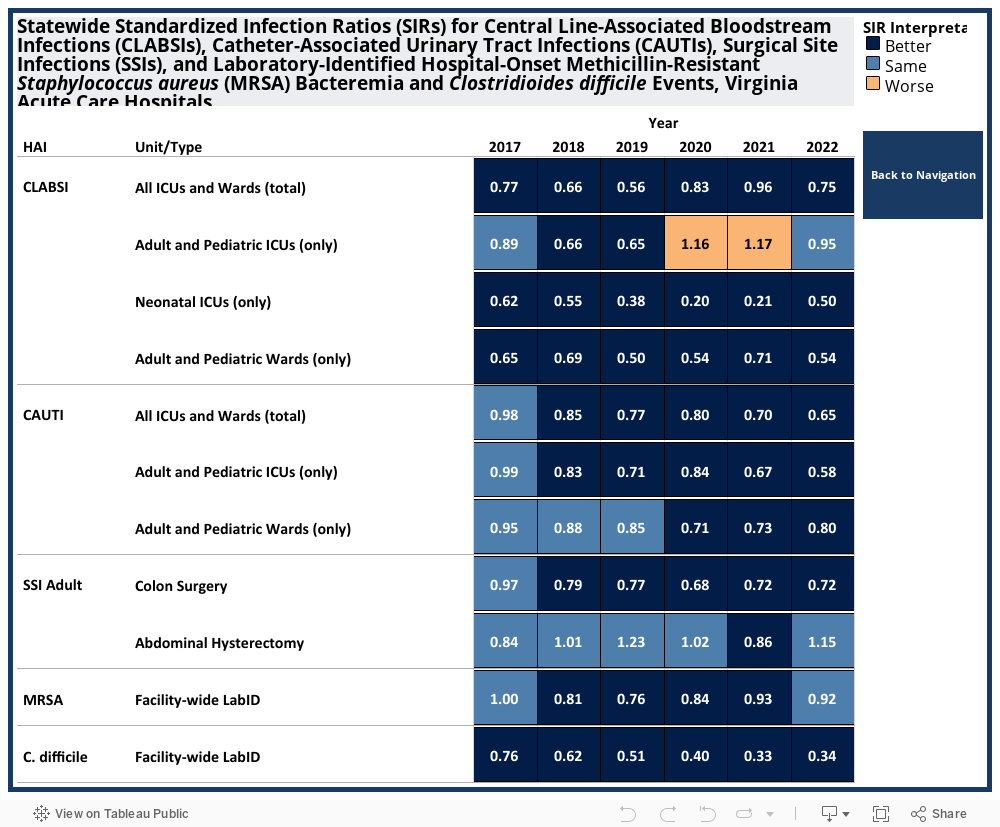
此選項卡按年份顯示全州所有可報告 HAI 的 SIR 數據。 SSI SIR 是基於成年病患 (≥ 18歲) 的複雜入院/再入院模型。有關此模型的更多信息,請參閱CDC NHSN SIR 指南。
NHSN 為腫瘤科密集治療單位(ICU)提供了單獨的 CLABSI 和 CAUTI 風險模型;這些數據在這裡不分別顯示。腫瘤科療程序包括在 CLABSI 和 CAUTI 的總數中,但僅從 ICU 數據中排除。接下表中的醫院特定 CLABSI 和 CAUTI 總計包括腫瘤科病毒治療。
包括住院病房位置為成人和兒童醫療、外科和醫療/外科病房。
如需有關每個 SIR 的詳細資訊,請將滑鼠停留在表格中的 SIR 值上。
全州南部
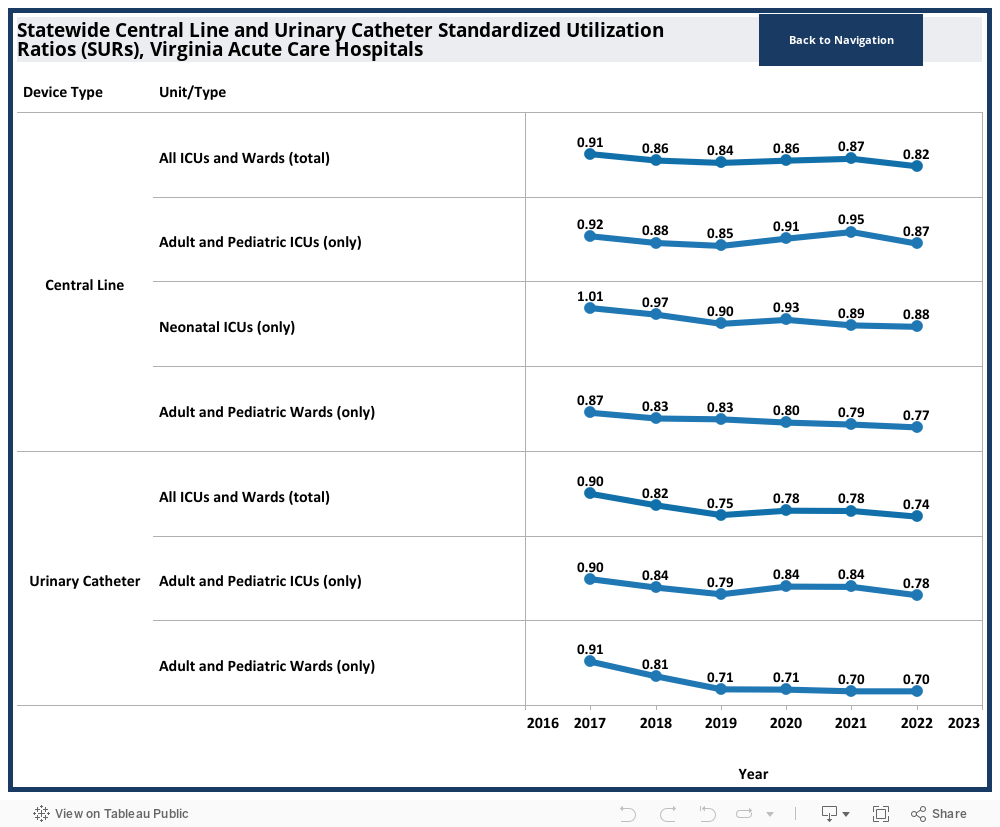
此索引標籤按年度顯示中央線路和尿管的全州 SUR 數據。NHSN 為腫瘤科密集治療單位(ICU)提供了單獨的風險模型;這些數據不分別在這裡顯示。腫瘤科療程序包括在中央線和導管使用的總數中,但僅在 ICU 的數據中排除。
包括住院病房位置為成人和兒童醫療、外科和醫療/外科病房。
如需有關每個 SUR 的詳細資訊,請將游標懸停在表示圖表中 SUR 值的圓上。
醫院特定報告
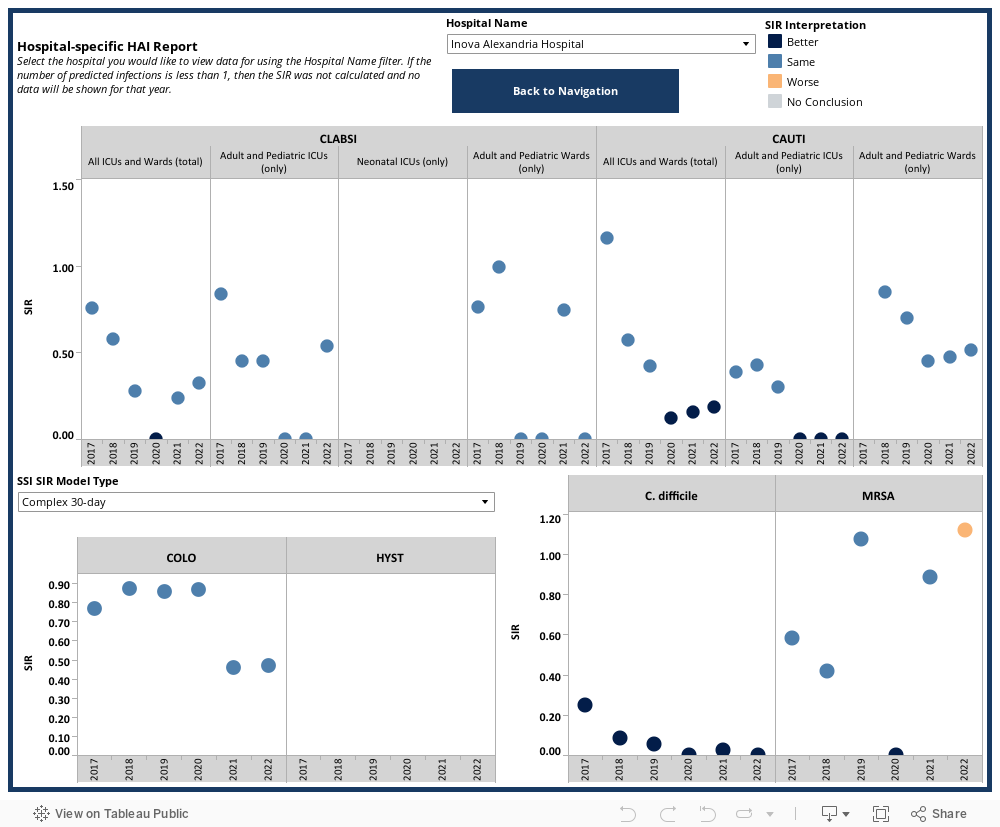
裝置 — 相關事件
此索引標籤顯示成人、小兒和新生兒密集治療單位 (ICU)、成人和兒童醫療、外科和醫療/外科病房中央線相關血液感染 (CLABSI) 的醫院特定資料,以及成人和兒童醫療、外科和醫療/外科病房的導管相關尿道感染 (CUCI) 的醫院特定資料。
如需有關每個醫院的 SIR 的詳細資訊,請將滑鼠停留在表格中的 SIR 值上方。
使用功能表中的篩選器來檢視特定醫院的資料。
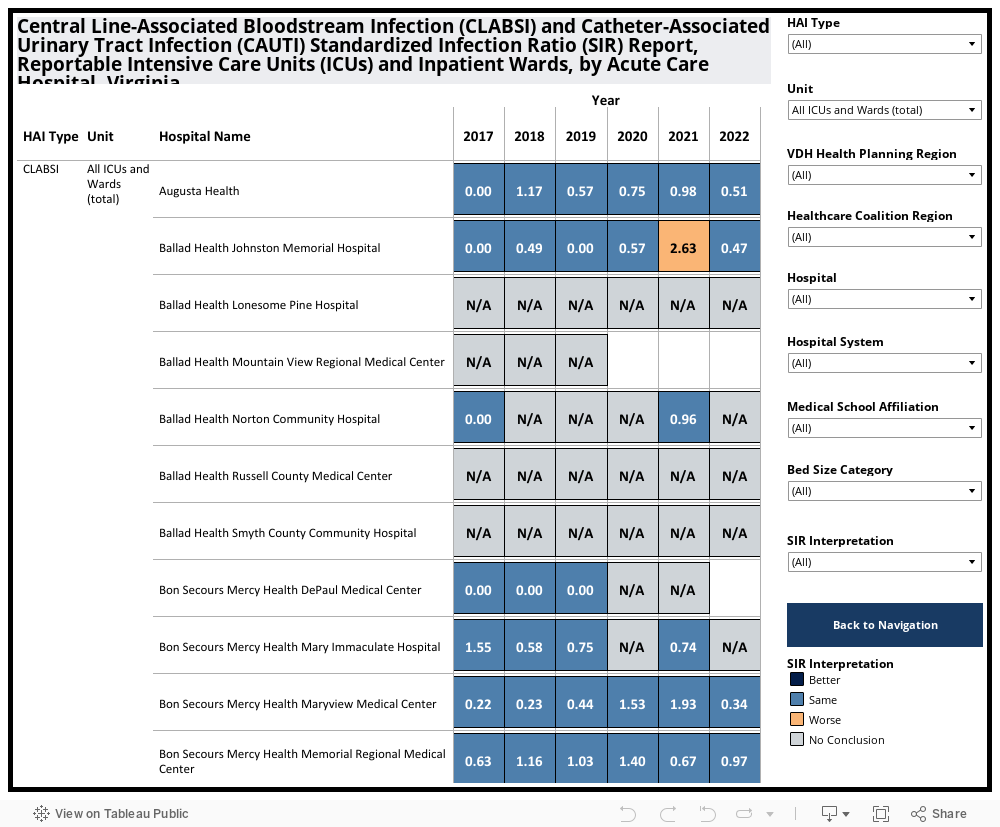
裝置使用率
此索引標籤顯示成人、兒童和新生兒密集治療單位 (ICU) 以及成人和兒童醫療、外科和醫療/外科病房的中央線使用的醫院特定資料,以及按年劃分的針對成人和兒童 ICU 和成人和兒童醫療、外科和醫療/外科病房使用尿管的醫院特定資料。
有關每家醫院 SUR 的更多信息,請將滑鼠懸停在表中的 SUR 值上。
使用選單中的過濾器查看特定醫院的資料。
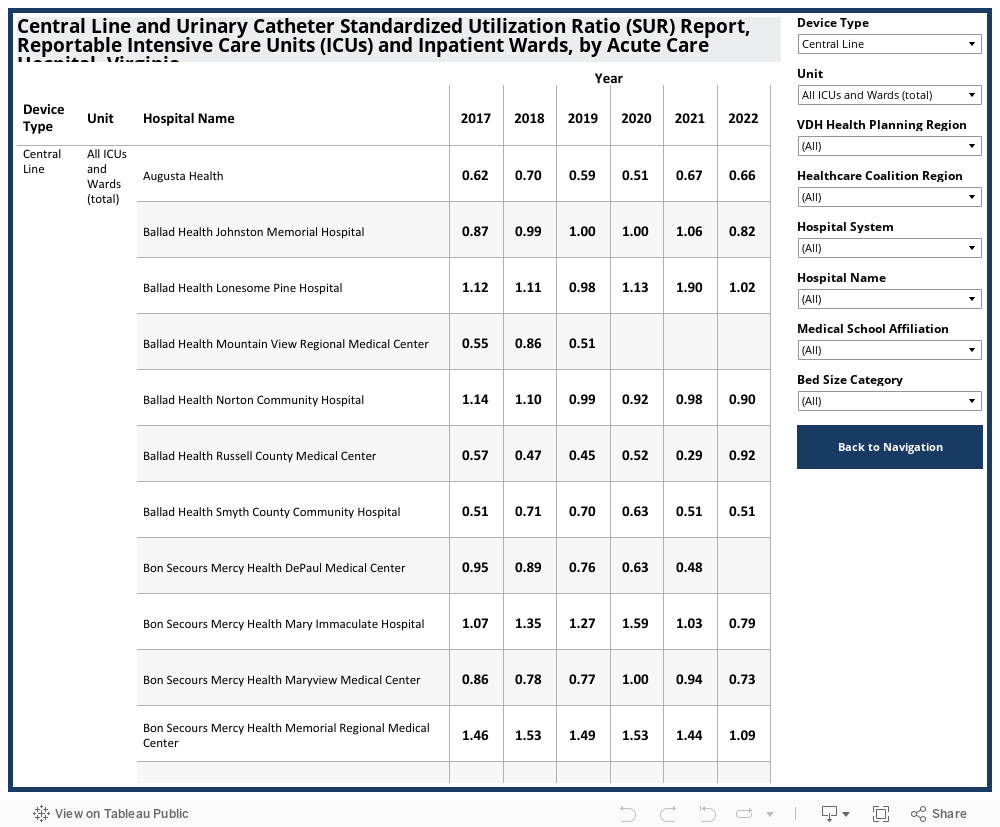
手術部位感染
此標籤按年份顯示成年患者 (≥ 18歲) 結腸手術 (COLO) 和腹部子宮切除術 (HYST) 後手術部位感染的醫院特定數據。 用於計算 SSI SIR 的模型可以在複雜入院/再入院模型和複雜30天模型之間切換。有關這些模型的更多資訊可以在 CDC NHSN SIR 指南中找到。
如果醫院在一年內進行一或多個外科手術,但預測的感染數量少於 1,則表中將顯示「N/A」。當您將鼠標懸停在單元格上時,SIR 解釋會說「沒有結論」。
如果醫院在該年沒有進行手術手術或沒有符合條件的手術,則該單元格將在表格中顯示為空白。當您將鼠標懸停在單元格上時,SIR 解釋會顯示「N/A」。
如需有關每個醫院的 SIR 的詳細資訊,請將滑鼠停留在表格中的 SIR 值上方。
使用功能表中的篩選器來檢視特定醫院的資料。
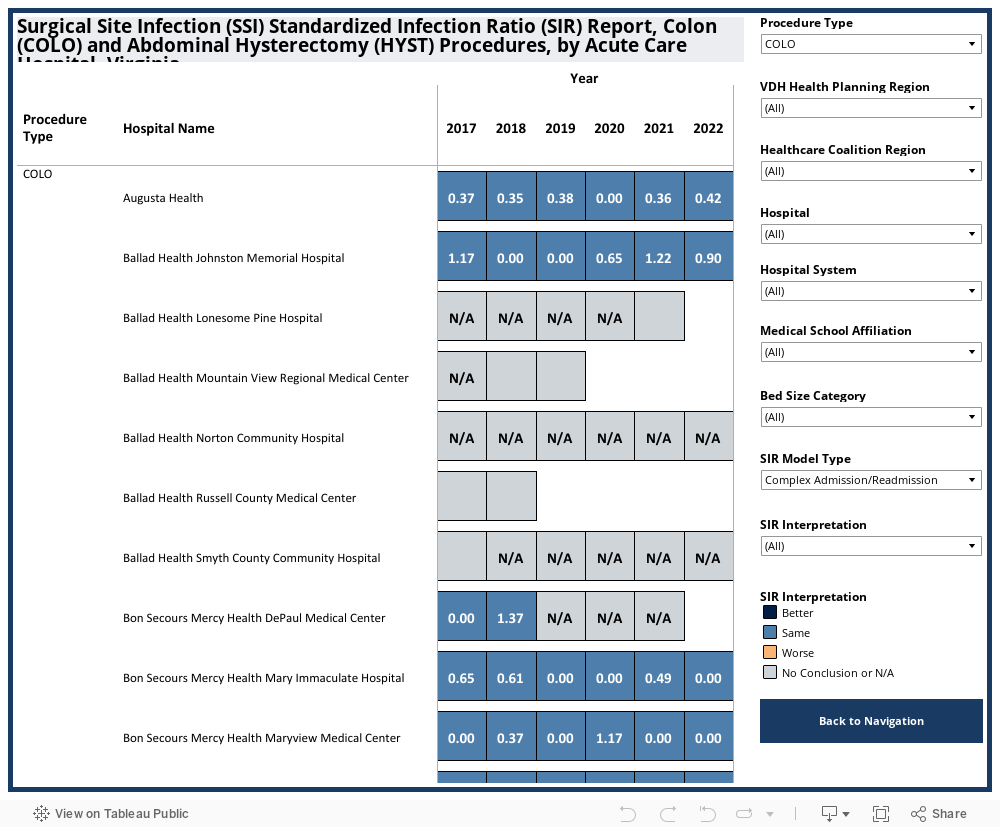
實驗室識別的事件
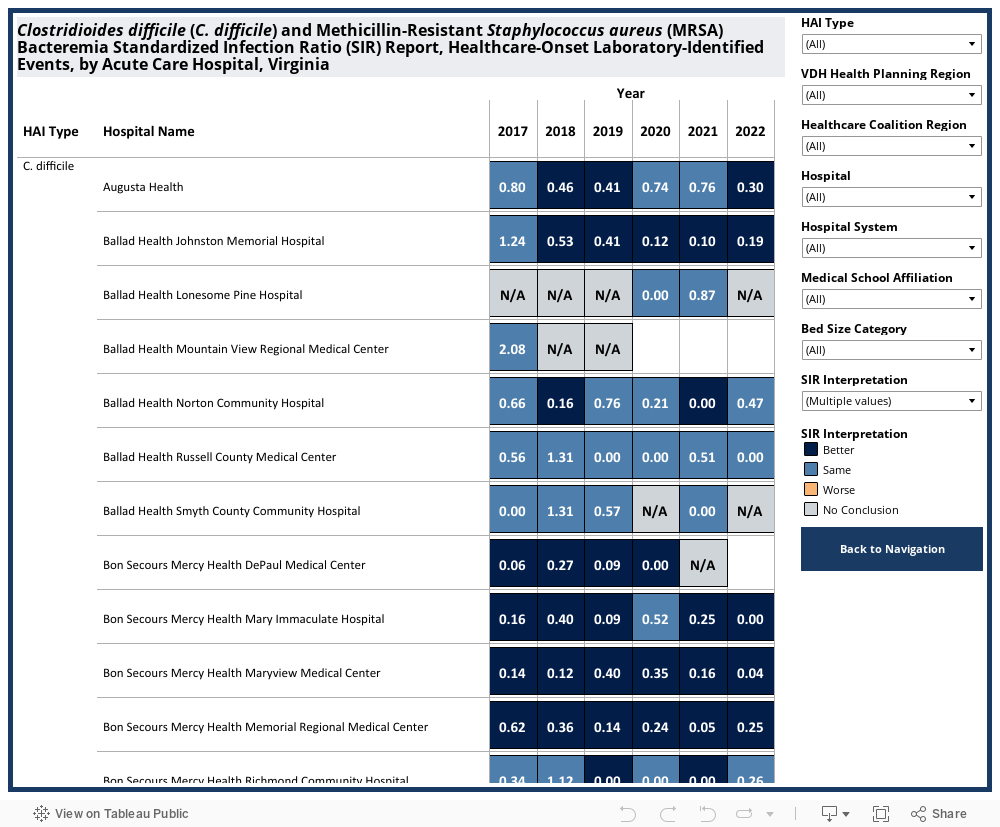
此索引標籤顯示醫療保健開發生實驗室識別的甲基西林耐藥金黃色葡萄球菌(MRSA) 和硬質曲線(C. difficile)事件 的醫
院特定資料 。 如需有關每個醫院的 SIR 的詳細資訊,請將滑鼠停留在表格中的 SIR 值上方。
使用功能表中的篩選器來檢視特定醫院的資料。
醫護人員流感疫苗接種
‘Healthcare personnel’ and ‘healthcare workers’ are used interchangeably. ‘Influenza’ and ‘flu’ are used interchangeably.
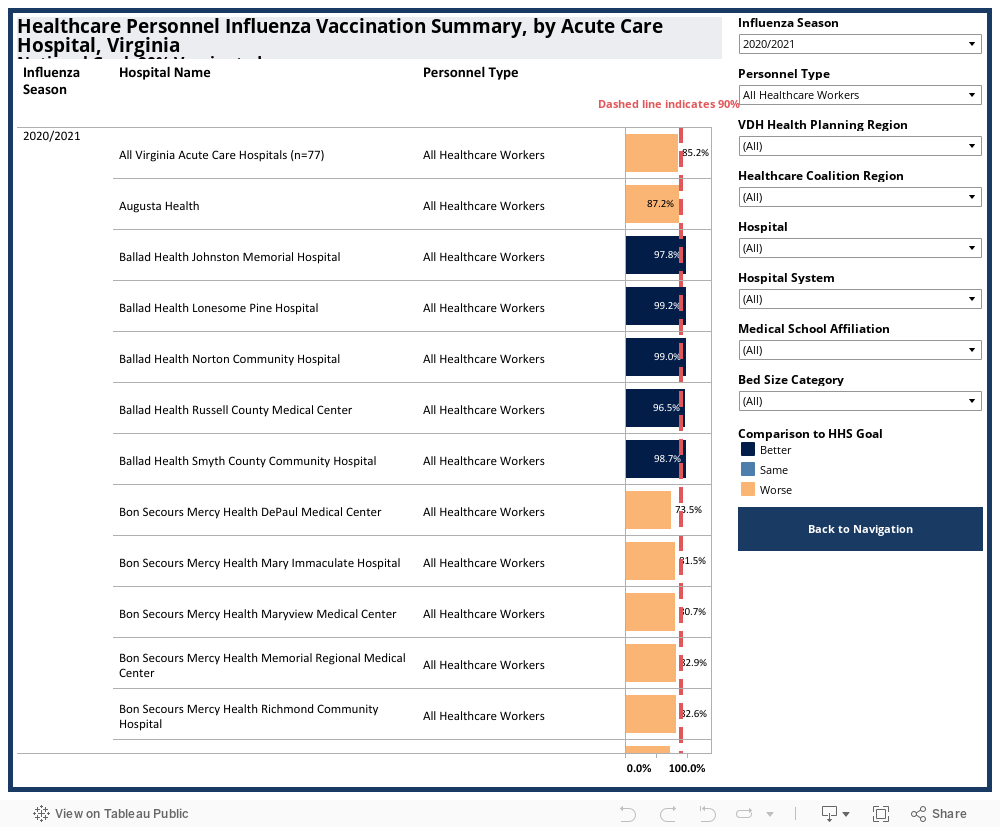
Percentage of healthcare personnel (HCP) in each hospital who were vaccinated during each influenza season (October 1-March 31), starting with the 2022-2023 influenza season. Healthcare personnel include employees, licensed independent practitioners, and adult students/trainees and volunteers.
The U.S. Department Health and Human Services (HHS) and Healthy People 2020 previously established a 90% influenza vaccination target for healthcare personnel. This target was removed under Healthy People 2030, which established a 70% vaccination target for all individuals in the U.S. aged 6 months and older.
Despite the change in national targets, The Advisory Committee on Immunization Practices (ACIP) and the CDC continue to recommend annual influenza vaccination for all healthcare personnel to reduce the risk for influenza and influenza-related morbidity and mortality for healthcare personnel and their patients.
For more information about each hospital’s HCP flu vaccination percentage, hover over the bars in the graph.
Use the filters in the menu to view data for certain hospitals.
To highlight HCP flu vaccination percentages that are Better, Same, or Worse, click the highlighter button to the right of ‘Comparison to HHS Goal’ and then select one of the categories.
下載國家衛生安全衛生動力系統數據。